• Feed
  • Artists
  • What's on
  • Calendar
  • Contact
Menu

Black Gully Printmakers

Street Address
City, State, Zip
Phone Number

Your Custom Text Here

Black Gully Printmakers

  • Feed
  • Artists
  • What's on
  • Calendar
  • Contact
Congratulations to our very talented member Leah Bullen for winning the Stanthorpe Art Prize - 2D Painting/Drawing AND Best in Show!

MEMORYSCAPE (GARDEN WITH SUNFLOWERS AND PENCIL PINES) 

Watercolour, gouache and monotype on paper

I started this work of a garden before the hardest part of the drought. For me gardens and gardening have always been a place and an activity centred around family, the beauty of nature and tranquillity. Memoryscape has gained a new currency over this challenging summer. It is a landscape of personal memories, daydreams and nostalgia — a landscape of ecological grief.

https://www.srag.org.au/sap-finalists/275-memoryscape-garden-with-sunflowers-and-pencil-pines-by-leah-bullen

#stanthorpeartprize 
#blackgullyprintmakers 
#monotype
Emily Simson
That dress!
Hand coloured linocut print    1/2
 
While carving the lino block I was thinking of every stitch made to create the beaded silk georgette 1920’s gown. 
 
A story to be imagined. With the absence of a maker’s label, who made the dress and where was it worn?
 
This print is for sale unframed
PAST PRESENT PRINT
Objects from the Armidale Folk Museum’s collections and the stories that underlie them. 

Armidale Regional Council foyer, 135 Rusden St, 9-4.30pm weekdays until March 19. 

#pastpresentprint
#armidaleregionalcouncil
#bgprocks
#armidale
#printmaking
#blackgullyprintmakers
Emily Simson
21st Century sampler
Monotype
 
The alphabet sampler stitched by Ellen Bremer (9yrs) in 1827 prompted me to think how a 9-year-old girl in 2021 would be more familiar with the language of emojis than learning needlework skills.
 
This print is for sale unframed.

PAST PRESENT PRINT
Objects from the Armidale Folk Museum’s collections and the stories that underlie them. 

Armidale Regional Council foyer, 135 Rusden St, 9-4.30pm weekdays until March 19. 

#pastpresentprint
#armidaleregionalcouncil
#bgprocks
#armidale
#printmaking
#blackgullyprintmakers
Eveline Chan
Tortoiseshell 1/10
Collagraph (intaglio) and chine collé on Kozo & BFK Rives 250 gsm

This print references a decorative tortoiseshell hair comb with Art Nouveau design detail from the Armidale Folk Museum Collection. 

This print is for purchase unframed.

PAST PRESENT PRINT
Objects from the Armidale Folk Museum’s collections and the stories that underlie them. 

Armidale Regional Council foyer, 135 Rusden St, 9-4.30pm weekdays until March 19. 

#pastpresentprint
#armidaleregionalcouncil
#bgprocks
#armidale
#printmaking
#blackgullyprintmakers
Jennifer Miller
A stitch in time
Dry point etching on Arnhem rag paper with chine colle vintage clothes pattern 
 
Smocking is a style of embroidery holding pleats which can be fixed or provide some elasticity to a garment. It’s been used for hundreds of years for both practical and decorative purposes with smocks having been worn by both men and women over that time.
 
Smocking is a labour-intensive craft, mostly undertaken by women. It wasn’t until the early 19th century, for example, that smocking dots and templates were used. Although pleaters or gathering machines were introduced at the turn of the 20th century, they didn’t become popular till the 1980’s. 
 
Craft magazines became more widely available in the 1940’s and with them a resurgence of interest in smocking. I remember a 1950 studio portrait of my older brother that used to hang in my parents’ house in which he’s wearing a light blue smocked shirt and short pants. I
Jennifer Miller
Women’s work
Solar plate and dry point etching on handmade paper
Unique state
 
A community of Mercy sisters was established in Emmaville in 1885 not long after tin had been discovered. In its heyday, the population was around 7000, but by the 1950’s had decreased to around 900, which probably meant that most inhabitants were known to each other. 

This beautiful Christening dress was hand sewn by one of the Mercy nuns to celebrate the 1949 birth of Robert Stevenson, one of the local Anglican families. 
 
What initially drew me to this dress was the lovely hand sewing.  How many hours did it take? How poignant is it that it was made by a woman who would never have children? Did the fact that she didn’t have family responsibilities free her up to have the time for this delicate sewing? What was the nature of women’s work at that time?
 
The garment finished up in the dress-up box for many years but has now been rescued by Robert’s wife, Deb.
Jules Harris
Young Amazon 1/5
Linocut print
 
In Aboriginal societies men and women had been working together in managing bushfires for 60,000 years before the arrival of European settlers, but in 1901 the gender roles of the colonialists were still very divided. Women were only just beginning to make inroads into fields traditionally held by men.
 
The Armidale Folk Museum holds an example of a brass NSW fire brigade helmet which is similar to that worn by an extraordinary bunch of young women who formed Australia's only all-female fire brigade between 1901 and 1903. 
 
'The Amazon Ladies Fire Brigade' was an initiative championed by Captain J.T.A Webb, Armidale's then fire chief, who modelled it on similar crews based in British girls’ schools.
 
Captain Webb's daughter Minnie was Australia's first female fire chief, leading her team of volunteers in full training drills and firefighting expeditions alongside the salaried male brigade.
 
These youn
Jules Harris
Lacework 1/10
Linocut print
 
This print is inspired by the intricacy and beauty of the lacework featured on an ivory lace ball gown in the Armidale Folk Museum's collection.
 
I love that the patterns and floral motifs are so freeform, an ever-changing flow showcasing the skills and imagination of the lace makers of this piece who invented the unique design as they went. It may be an example of crochet lacework, a more freeform and open form where motifs are first crocheted and then woven together.
 
Hand-made lacework flourished in Great Britain and Europe from the late 16th century and continued to become more intricate and highly valued well into the late 1800s when the industrial revolution introduced machine made lace.
 
Lace was a luxury commodity, worn by the wealthiest women and made by the poorest, but played a vital part in saving many families from starvation, particularly in countries like Ireland.
 
Making the linocut carving for this
Jules Harris
The ancestors 1/5
Hand coloured linocut print
 
My work is inspired by a piece of scrimshaw that is held in the Armidale Folk Museum collection. Scrimshaw is an art form traditionally made by sailors who etched or engraved images into the by-products of whaling, typically whale teeth or bones. The images were commonly of loved ones who awaited the sailors back at home.

The museum's example consists of a single buffalo or cow horn that has portraits of men and women artfully engraved on all sides. I was particularly taken by the artist's stylised way of evoking the individuality of each person, reflected in the simple but effective lines used to draw their faces hairstyles and the unusual patterns in their clothing which to me also suggested an ethnic sensibility.

This piece raised many questions for me. Was the artist a sailor? Where was he (or she) when this was engraved? Were these people family? Was this intended as a gift? The subjects are dressed in their finery so
Kelly Lye
Not corrupted by the hurrying hand  U/S (detail)
Linocut and letterpress on Fabriano Tiepolo paper
 
A tribute to the in-disposable, enduring items in the Folk Museum collection, which were made to last and be reused; and to the time taken to use them well and appreciate the results - a parallel with the equipment in the Wimble collection in the Museum of Printing that was used to create this print, and a contrast with the disposable culture of today, embodied by takeaway coffee cups. The title is taken from Beatrice Warde's well-known "This is a Print Office" manifesto that hangs in MoP.

This print is for sale unframed

PAST PRESENT PRINT
Objects from the Armidale Folk Museum’s collections and the stories that underlie them. 

Armidale Regional Council foyer, 135 Rusden St, 9-4.30pm weekdays until March 19. 

#pastpresentprint
#armidaleregionalcouncil
#bgprocks
Lizzie Horne
Stolen generations  U/S (variation ii)
Dry point etching mono print 
 
This work depicts a collection of birds' eggs that is housed in the Armidale Folk Museum.  The eggs were taken from nests, or "collected" between 1905 and 1917 in a practice that was quite common and acceptable at the time. It is now illegal. 

The mono print technique utilised here is a relief roll of ink applied with a brayer on top of an inked matrix, then wiped back with various implements. 
 
www.lizziehornecreative.com
 
This print is for sale unframed. 

PAST PRESENT PRINT
Objects from the Armidale Folk Museum’s collections and the stories that underlie them. 

Armidale Regional Council foyer, 135 Rusden St, 9-4.30pm weekdays until March 19. 

#pastpresentprint
#armidaleregionalcouncil
#bgprocks
Lizzie Horne

Dream of flight U/S (detail) 

Dry point etching mono print

Inspired by the eggs taken from nests in the name of “nature studies”. Holes were made in them to allow the contents to be sucked out, and the empty shells displayed as trophies in the Armidale Folk Museum’s collection. Today this practice is seen as theft and is illegal, but at the turn of last century was popular and widespread, with no thought to the generations of birds wiped out.
 
www.lizziehornecreative.com
 
This print is for sale unframed

PAST PRESENT PRINT
Objects from the Armidale Folk Museum’s collections and the stories that underlie them. 

Armidale Regional Council foyer, 135 Rusden St, 9-4.30pm weekdays until March 19. 

#pastpresentprint
#armidaleregionalcouncil
#bgprocks
Susie Spencer

Queen Anne's Lace V
 
Monotype on Fabriano Tiepolo
 
The Queen Anne's Lace is in full flower up and down our road. I liked the idea that it's a naturalized plant as are the folk who settled in Australia from around the world. The flower imagery made me think of the cabinet of wedding clothes in the Folk Museum. Voila. 
 
This print is not for sale.

PAST PRESENT PRINT
Objects from the Armidale Folk Museum’s collections and the stories that underlie them. 

Armidale Regional Council foyer, 135 Rusden St, 9-4.30pm weekdays until March 19. 

#pastpresentprint
#armidaleregionalcouncil
#bgprocks
Rhonda Ellem
Lace plant VE 1/10
Lino print on rag paper    
 
I was interested in the detail of an ivory lace ballgown laying in a display cabinet in the Folk Museum. Its folds reveal vegetative lace motifs of delicate flowers, fern fronds, blocked in heart-shaped leaves and organic forms that swirl around the main shapes. All are connected with structural spiderweb-like threads.
 
I’ve been told this could be the technique of needle-lace where commercial tape is joined with bars of needle-lace stitching.
The ball gown is dated to 1910 but its origin is unknown. It’s a ball gown without provenance, so we don’t know the stories of its maker and/or wearer. Can only imagine and wonder.
I was attracted to the design qualities of the work and its meticulous handiwork which reads as an artform. I’ve selected a small section and worked with its positive and negative areas.
 
This print is for sale unframed.

PAST PRESENT PRINT
Objects from the
Rhonda Ellem
The escape of the Bengali tiger, US 1/1
Hand coloured linocut print
 
I’ve given a different account to the story depicted in the original set of seven glass magic-lantern slides in the Folk Museum.
 
The original is a comic story told in seven graphically painted scenes, of two Anglo-Indians of Bengal who decide to have a picnic near some palm trees. They begin to indulge themselves in the food and drink, packed by the men’s servants into a barrel. However, the picnic is interrupted by the arrival of a Bengal tiger. The men run around and around in fear, avoiding the tiger until they successfully capture it by dropping the barrel over its body. They stand on the barrel thinking they’ve secured the tiger, but they’re trapped! They cannot leave without releasing the animal. Fortunately, as luck would have it the tiger’s tail pokes out of the bunghole of the barrel and the men tie a knot in the tail and successfully tether it.
 
T
Diana Perry
Breakfast lunch and dinner 1/1 (detail)
Stereotype and metal-type
NFS

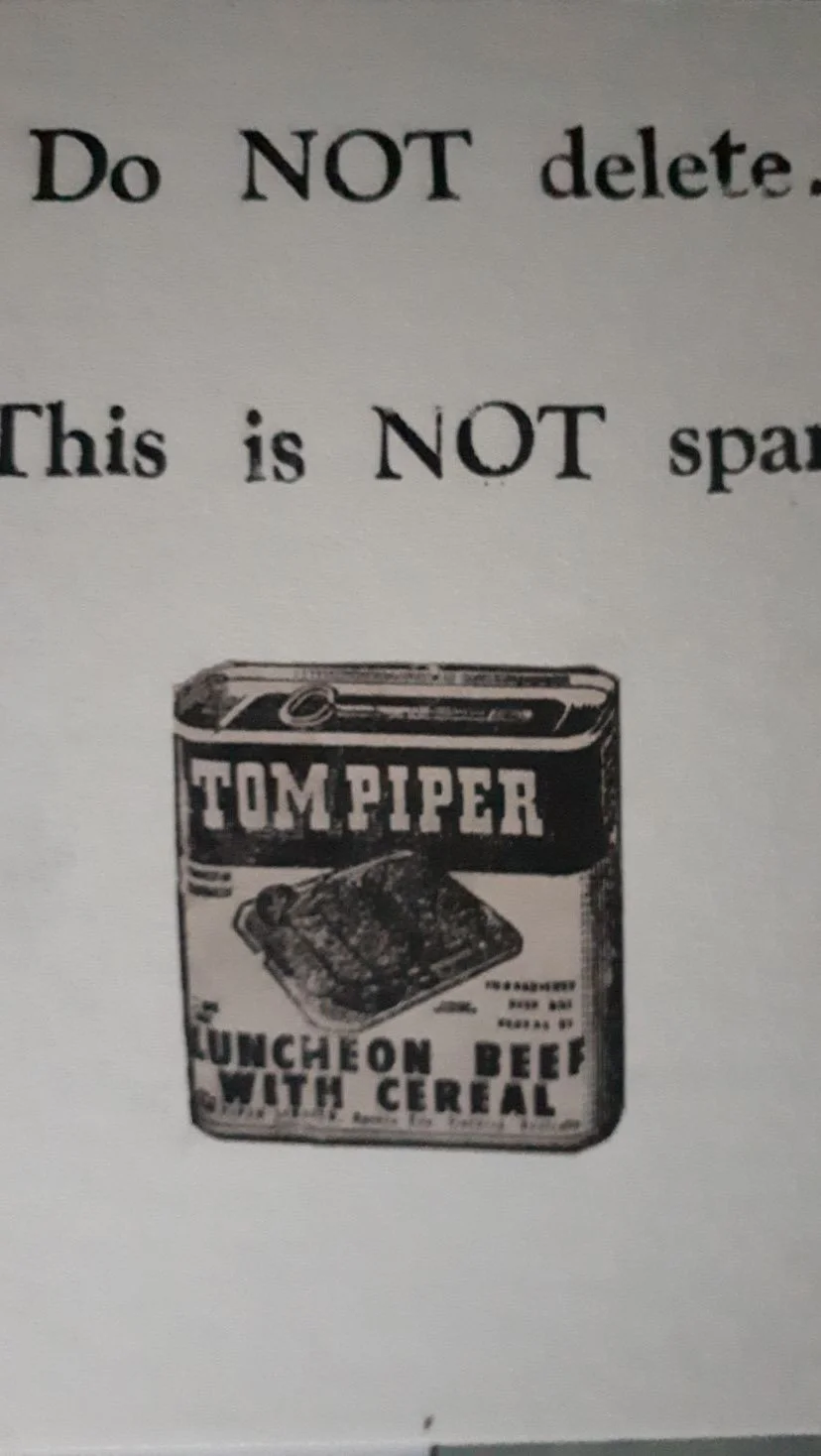
A relief print using advertising stereotypes donated by the Folk Museum to the Museum of Printing, NERAM. These include advertisements for all sorts of processed foods, household gadgets, clothing, and shoes.  I chose to focus on food. The image was inspired not only by these stereotypes, but by the displays of cans, packages and household goods in the Folk Museum, especially in the Post Office and General Store display. 
 
Stereotypes are zinc images, logos, and text mounted on wooden blocks. They can be used over and over again, so that there is no need to reset them for each edition of a newspaper or magazine. They are set and inked with the text body to be printed. 

PAST PRESENT PRINT
Objects from the Armidale Folk Museum’s collections and the stories that underlie them. 

Armidale Regional Council foyer, 135 Rusden st. Weekdays 9-4.30 until March 19. 

#pastpresentprint
#armidaleregionalcounc
Diana Perry
Come dance with me  1/3
 
Collagraph of plastic and lace, relief printed.
 
Based on the idea of the little black dress. There is a dress with a handkerchief hem displayed in the Folk Museum. This was definitely a party dress, and I like to think of the special occasions it has seen, the pleasure it gave its wearer.
 
NFS

PAST PRESENT PRINT 
Objects from the Armidale Folk Museum’s collections and the stories that underlie them. 

Armidale Regional Council foyer, 135 Rusden St. Weekdays 9-4.30 until March 19.

#pastpresentprint 
#armidaleregionalcouncil 
#bgprocks
In collaboration with Armidale Regional Council

Taking inspiration from the Armidale Folk Museum 

An exhibition of prints in the Council Chambers foyer from 9 to 4.30pm weekdays

#pastpresentprint 
#armidaleregionalcouncil
BGP CHRISTMAS SHOW

Eveline Chan
 
To New York, With Love
 
Multi-block linocut print in red, yellow and blue
150 x 150 mm
Hand printed on Awagami Kozo 110 gsm
 
This print is a 3 block linocut rendition of Robert Indiana’s LOVE street sculpture in New York, which I stumbled upon with some excitement while wandering the streets of Manhattan in 2018. The artist’s original design concept was for a Christmas card for MOMA in 1965. 

I made this print for my daughter who lives in NY, after the first wave of COVID-19 devastated NYC in early 2020. The restrictions at the time turned my focus to essential things – love, primary colours, hand cutting and hand printing.  Each colour was printed from a separate block, with each layer of colour superimposed while the ink was still wet.
BGP CHRISTMAS SHOW

Emily Simson

Roses and jug
3 plate collagraph

In autumn 2020 some magenta coloured roses in a decorative jug became the subject for a series of drawings. I made a few printing plates in plywood to expand the theme into print form but became distracted by the plates as stand alone artworks! 

The print shown here is a result of trying out 3 plates made with yellow, red and blue in mind. This is one variation made by wiping away selected areas on the yellow plate and leaving more ink in the textured shapes on the red plate. 

@emilysimson.art